
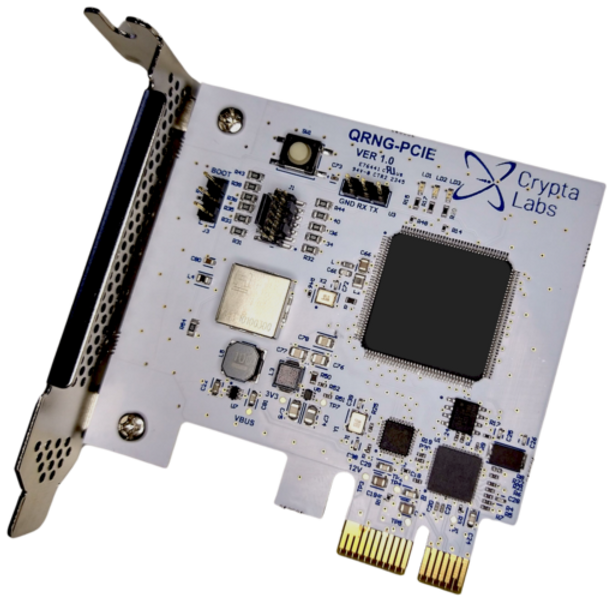
Last year I worked with Cryptalab on the design of a quantum random number generator card.
SSL/TSL experts know how important this is in today's world.
Visit their website at https://cryptalabs.com/ to learn more about this excellent product
There is a detail in this kind of design (PCIE cards) that I want to tell you about from an EMC perspective so that you won't make a mistake that I have seen many times in my years of troubleshooting for EMCs.
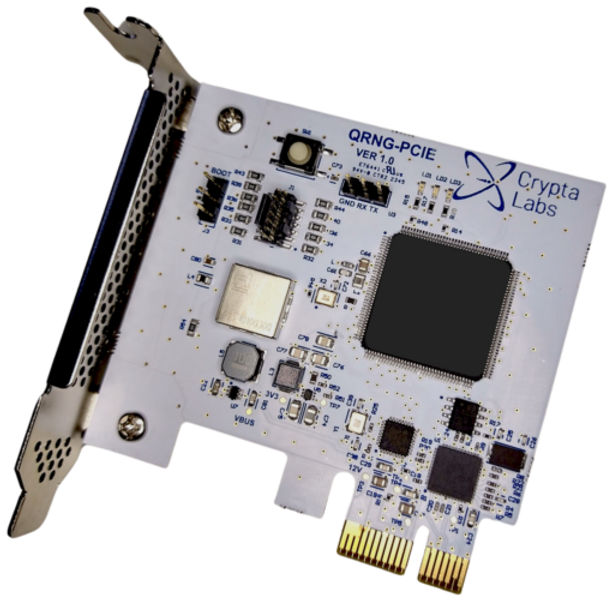
Cryptalab PCIE card
There are times when designing a PCIE card or a PCI card, the bracket that holds the card to the chassis can present some challenges.
As a troubleshooter, I have seen two kinds of mistakes during my years of troubleshooting
-
Emissions due to a insulated braket
-
ESD failure due to connecting the bracket to GND.
In order to begin the discussion, let's take a look at the first issue
Typical error #1 Emissions due to a insulated braket
There has been a trend lately where companies are using an insulated bracket (for example, a bracket that is black) for marketing purposes, which looks so cool and is so appealing to the eyes.
What a pity that sometimes this results in radiated emissions, and your product fails as a result.
Those of you who have read one of my previous posts will definitely know by now that an antenna is made up of three main elements. This consists of a metal piece, a feeder and a ground plane.
In a case where you are using an insulated bracket (for example, a bracket painted black and therefore is not ohmically connected to the Desktop chassis), the bracket may act as a patch antenna and may resonate in the range of frequencies between 200 MHz and 1 GHz.
It should be noted that the antenna elements in this case are the bracket (the antenna), the chassis (the ground plane), and the motherboard (the feeder).
It is essential that the bracket should be not insulated at least in one point from the chassis in order for this antenna to be "broken".
So... try to avoid a painted bracket, and if you must, then use a mask in one point to make sure you "break" the antenna.
Typical error #2 Failing ESD, due to the bracket connected to PCB GND
As part of the ESD testing process, a few kV will be applied to the bracket (usually between +- 2 kV and +- 4 kV). It can be argued that if the bracket, which is connected to the chassis, is also connected to the PCB ground, then there is potentially a return path going from the bracket to the PCB ground, to the earth (in some form).
In this situation, if you are lucky, it happens that the desktop will be reset, but if you are unlucky, the desktop will be damaged.
In both cases, you fail the test.
So... try to avoid the pitfalls described above.
It would be my sincere hope that if you have read this you are not going to be my customer (at least not for this issue).
See you next time
Written by Francesco Poderico
About the author
These articles are Francesco Poderico's work. He built EMC Design Solutions around a simple idea: EMC is not black magic, and every failure has an explanation. When he closed the company, he passed his writing to us so it could keep helping engineers. We publish it unchanged.
Facing a problem like this one?
We help hardware teams find the root cause and pass. Start with a call, or map the rules that apply to your product first.
More on EMC
EMC
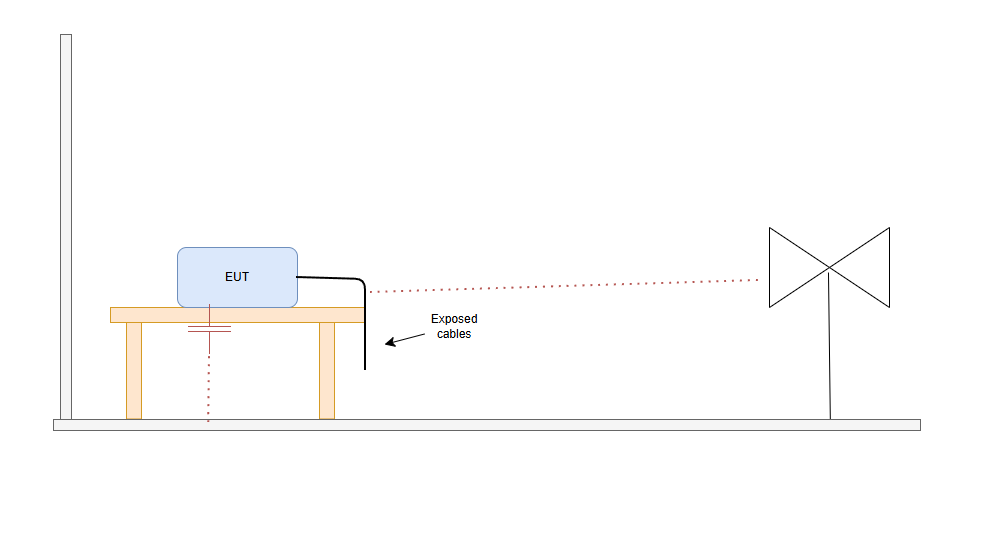
Why Moving the EUT Changes the Emissions Plot
Rotate the product, lift a cable, move it 20 cm, and the radiated emissions plot changes. That is not randomness: the cable is the antenna. How to read those changes while debugging.
Francesco Poderico · · 3 min read
EMC
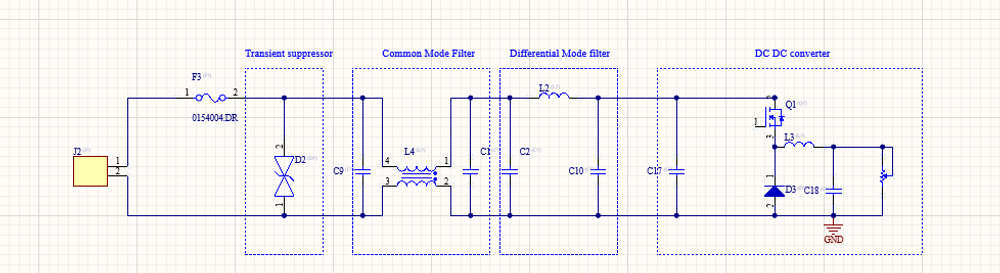
Power Supply Emissions: How I Separate Differential Mode from Common Mode
One bench test tells you whether DC/DC converter emissions are differential or common mode: change the load and watch the amplitude. What each result means and where to fix.
Francesco Poderico · · 3 min read
EMC
Identifying Low di/dt and High di/dt Currents in DC‑DC Converters
Not all currents in a switching converter matter equally for EMI. How to identify the high di/dt loops, why they dominate emissions, and the layout and gate-driver choices that tame them.
Francesco Poderico · · 4 min read