
The 2023 was the busies time ever. Because of all the projects I had, I barely had time to write articles for EMC.
In this year, I've already got 25 EMC designs to fix and a few products to design. In any case, I'll try to be as active as I can, and share some of my design knowledge with you.
You should know by now that I share information that you can't easily find in "books" or might not even exist, or if it does exist I'm not aware of it.
Have you seen the movie "Ocean 11"? When they blacked out Las Vegas for 30 seconds using the "pinch".
There is some truth to that. If an EMP or pinch happens, 99.99% of all electronic devices (powered) will be irreparably damaged.
Moreover, since commercial electronic equipment is not built to withstand an EMP, the damage will not last only 30 seconds, but forever. Despite the power coming back, phones, computers, video cameras, etc. will not be back to normal.
Anyway... People at ESA or NASA are experts on this subject. They need to design electronics for a harsh environment since space is full of particles such as alpha, beta, gamma, X-rays, neutrons, positrons, electrons, etc.
While particles like alpha, beta, don't really have enough energy to create any real damage (at least in the space environment), on the other side particles like Gamma Rays and the others, may have enough energy to create a unwanted change of state for one or more CMOS.
Anyway, let's see what will be damaged, and why.
-
99.9 % of all digital circuit will get damage.
-
Analog circuits are not all affected by damage, but some operational amplifier topologies may.
Here are some reasons why a digital circuit might fail.
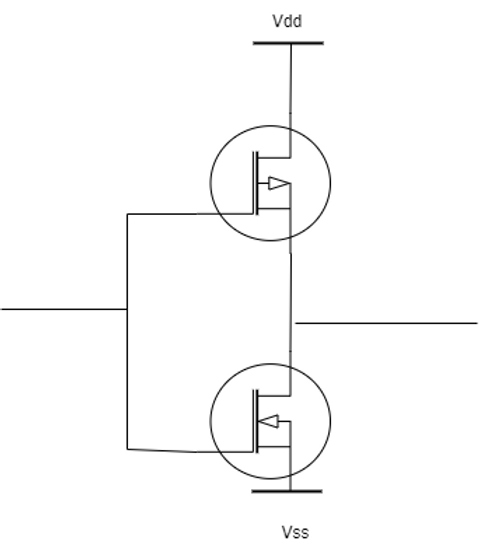
In typical CMOS gates, N-MOS and P-MOS are combined.
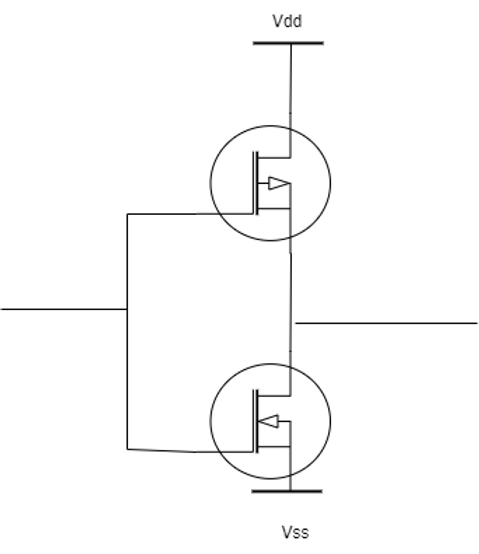
For the sake of argument, let's assume the PMOS is conducing and Vout = Vdd.
Let's imagine a particle of such high energy hitting the gate of the NMOS and causing it to fully conduct.
Then what happens?
We will find ourselves in a condition where both PMOS and NMOS are conducing, and therefore, a large current will pass from Vdd -> PMOS -> NMOS -> Vss, permanently damaging the CMOS.
Therefore, if the Pinch had struck in the case of Ocean 11, every mobile phone, computer, slot machine, TV, radio, etc. would have been destroyed.
Is that interesting? It is indeed interesting.
Can electronics be designed to protect against the pinch? The answer is yes. There are some design techniques that can be used to protect against.
If you want to know more about this subject let me know in the comment and I will write more articles on the subject, otherwise I will continuew writing articles on EMC.
Written by Francesco Poderico
About the author
These articles are Francesco Poderico's work. He built EMC Design Solutions around a simple idea: EMC is not black magic, and every failure has an explanation. When he closed the company, he passed his writing to us so it could keep helping engineers. We publish it unchanged.
Facing a problem like this one?
We help hardware teams find the root cause and pass. Start with a call, or map the rules that apply to your product first.
More on EMC
EMC
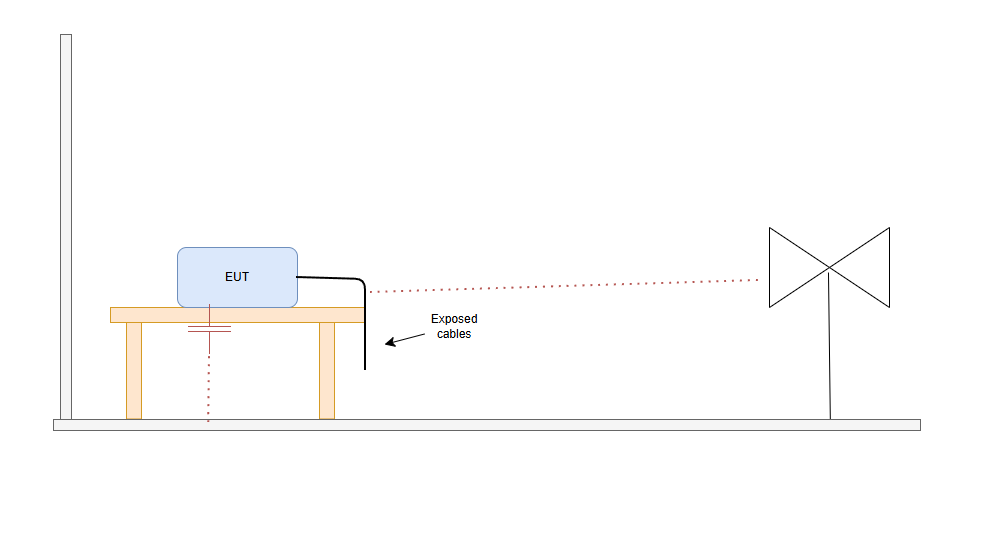
Why Moving the EUT Changes the Emissions Plot
Rotate the product, lift a cable, move it 20 cm, and the radiated emissions plot changes. That is not randomness: the cable is the antenna. How to read those changes while debugging.
Francesco Poderico · · 3 min read
EMC
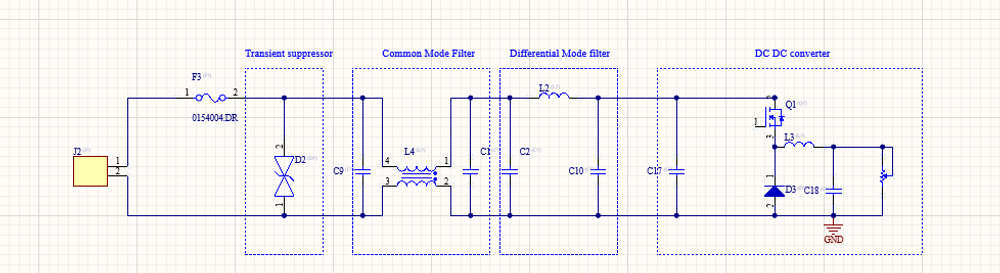
Power Supply Emissions: How I Separate Differential Mode from Common Mode
One bench test tells you whether DC/DC converter emissions are differential or common mode: change the load and watch the amplitude. What each result means and where to fix.
Francesco Poderico · · 3 min read
EMC
Identifying Low di/dt and High di/dt Currents in DC‑DC Converters
Not all currents in a switching converter matter equally for EMI. How to identify the high di/dt loops, why they dominate emissions, and the layout and gate-driver choices that tame them.
Francesco Poderico · · 4 min read